Each article starts with a small question and explains one principle.
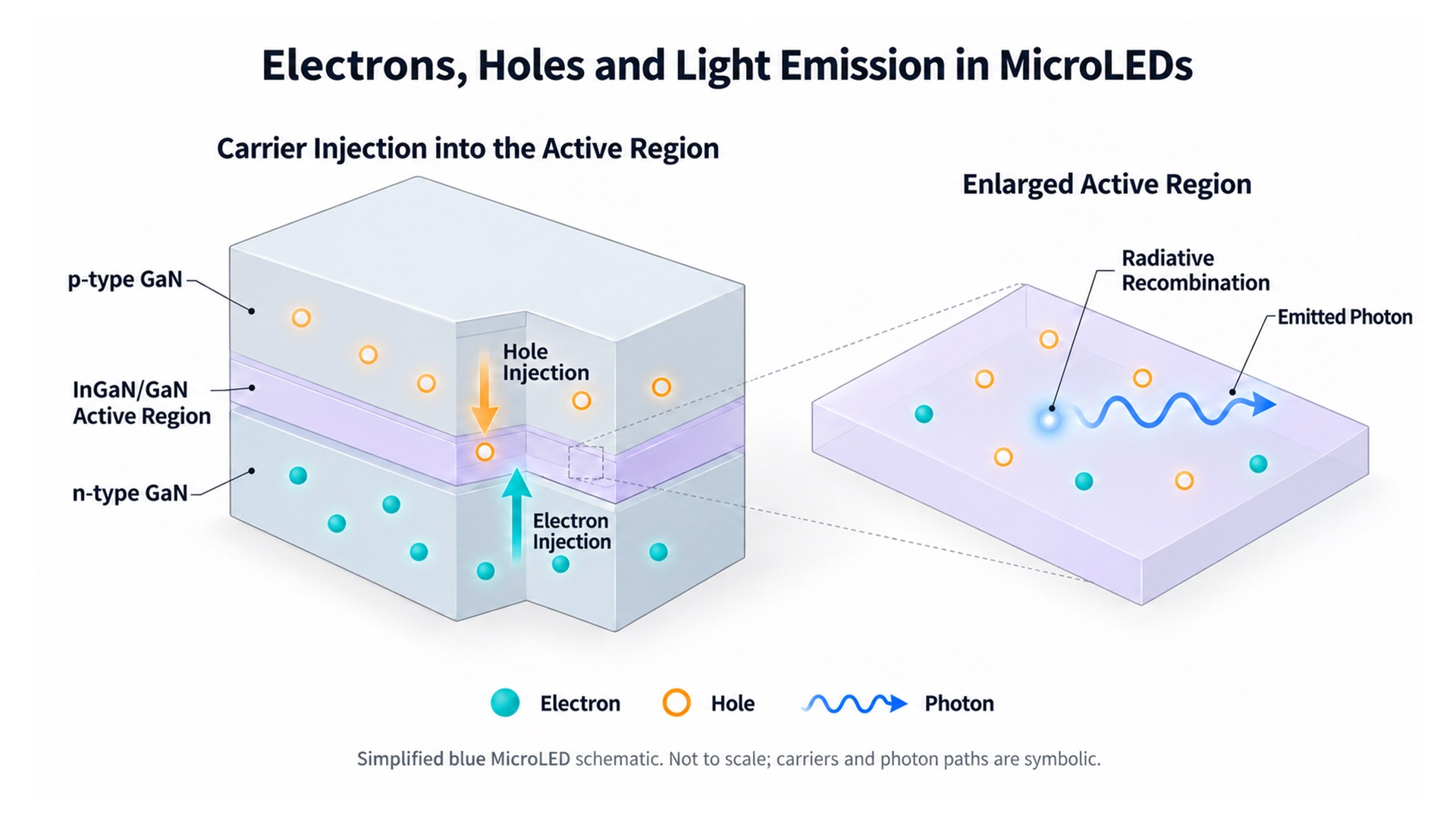
A MicroLED pixel produces light through electroluminescence. In a typical GaN-based blue MicroLED, electrically injected electrons and holes recombine in the chip’s active region. When this recombination releases energy as photons, light is generated.
Finding the region where light is generated
Viewed through its thickness, a MicroLED consists of several layers of semiconductor material. The light-emitting region, usually called the active region or light-emitting layer, lies between the n-type and p-type semiconductor layers.
In a typical blue MicroLED, the active region contains several very thin indium gallium nitride (InGaN) well layers, separated by barrier layers. These alternating wells and barriers form a multiple quantum well (MQW) structure.
An individual well layer may be only a few nanometers thick. That measurement refers to the thickness of one well, rather than the entire active region, which also includes the other wells and the barriers between them.
The choice and arrangement of these materials help confine the electrons and holes involved in light emission within the wells. The well thickness, material composition and arrangement of the barriers all affect how electrons and holes are distributed, which in turn influences how they recombine and emit light.
Locating the active region is the first step. Next, we need to see how electrons and holes reach it when power is applied, and how they produce light.
How electrons and holes produce light
An electron is a negatively charged particle. A hole is an unoccupied state in a semiconductor that could otherwise be occupied by an electron. In charge transport, it behaves as a positively charged carrier. Electrons and holes both participate in charge transport, so both are called charge carriers.
When a suitable forward voltage is applied across the chip, electrons are injected into the active region from the n-type side, and holes from the p-type side.
Within the active region, an electron can move from a higher-energy state to an unoccupied state at a lower energy. This transition corresponds to an electron recombining with a hole.
If the energy released in this event is emitted as a photon, the process is called radiative recombination. This is the step at which light is generated.
Light emission through the recombination of electrically injected carriers is called electroluminescence. This is how a MicroLED pixel produces its own light when powered.
As the pixel remains lit, large numbers of electrons and holes continue to enter the active region. Radiative recombination occurs repeatedly, producing many photons. The steady point of light we see is the combined result of many microscopic emission events.
Not every recombination event produces light
Electrons and holes entering the active region do not necessarily release their energy as light.
Some defects or impurities in the material introduce intermediate energy levels within the band gap. Carriers can recombine through these states without emitting a photon, with the energy ultimately becoming heat. This is one pathway for nonradiative recombination.
Once photons have been generated inside the chip, light still needs to escape and be collected. Some photons can leave the chip and then be captured by the optical system to help form the image we see. How much light is generated inside the chip and how much is ultimately used are two separate questions.
In this article, we have located the starting point of that light: radiative recombination taking place within the chip's active region.
In the next article, we will follow this light-emitting region to the edge of the pixel and look at why the sidewalls affect the process.