Hongshi Tech Insights
Each article starts with a small question and explains one principle.
To produce a color image, a MicroLED microdisplay needs light of different colors, including red, green and blue. One approach is to shine blue light from MicroLEDs onto quantum dot materials, which emit the other colors needed.
Solutions based on quantum dot photoresist (QDPR) use this color-conversion process. But what exactly are quantum dots? In this article, we take a closer look at the material itself.
What a quantum dot is
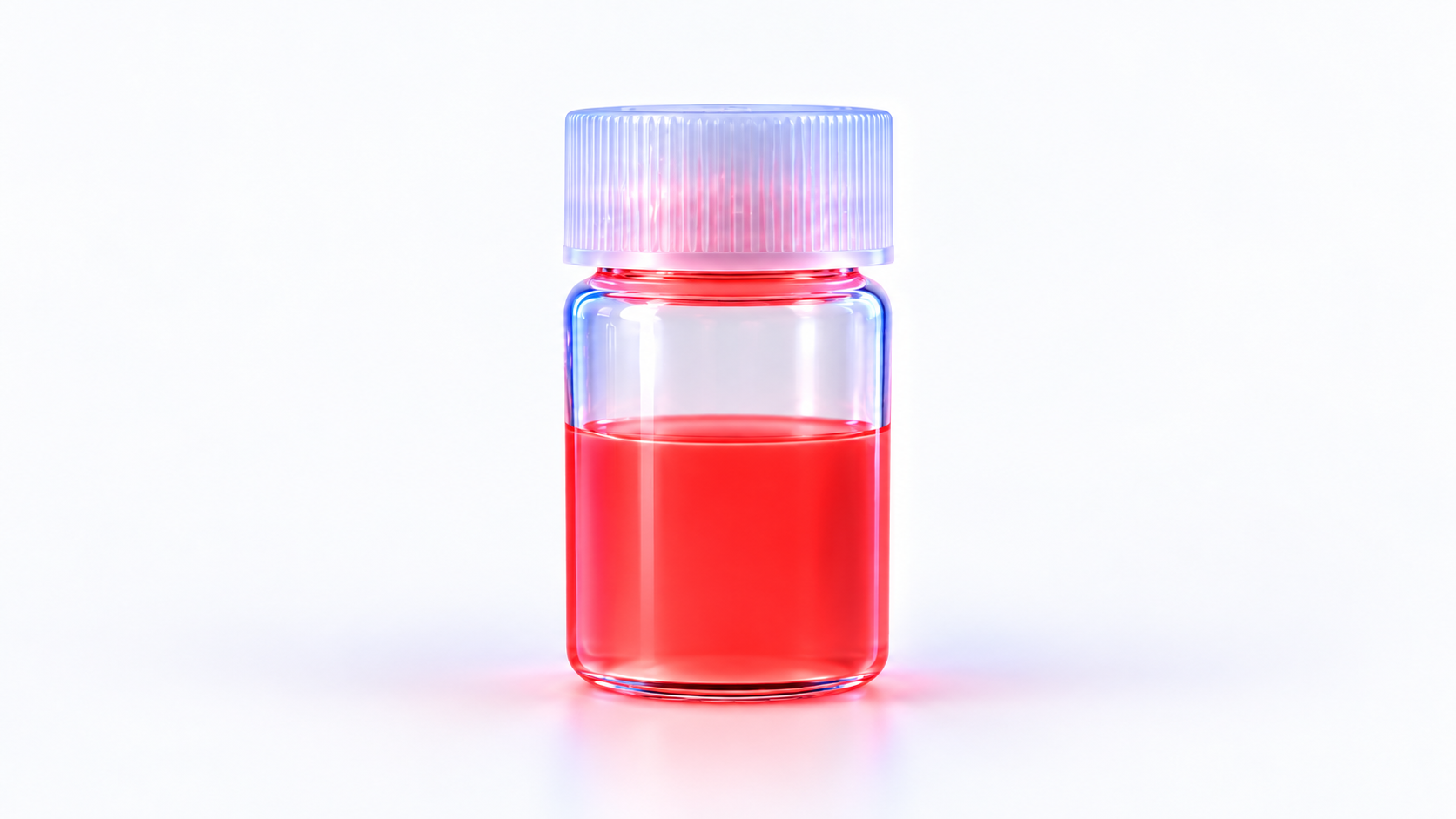
The quantum dots used in this type of MicroLED microdisplay are semiconductor nanocrystals. The term quantum dot is often abbreviated to QD.
A quantum dot can be just a few nanometers in size. One nanometer is one millionth of a millimeter, so an individual particle is far too small to see with the naked eye. Within the crystal, many atoms are arranged in an ordered structure, together forming a tiny semiconductor particle.
The color a quantum dot emits depends on factors such as its material composition and particle size. When composition, structure and other conditions are similar, changing the particle size can change the emission color.
These particles can be dispersed in a liquid or combined with other materials to form a film.
A quantum dot material may therefore come as a small vial of particle dispersion or as a thin film. In either form, large numbers of tiny quantum dots perform the color conversion.
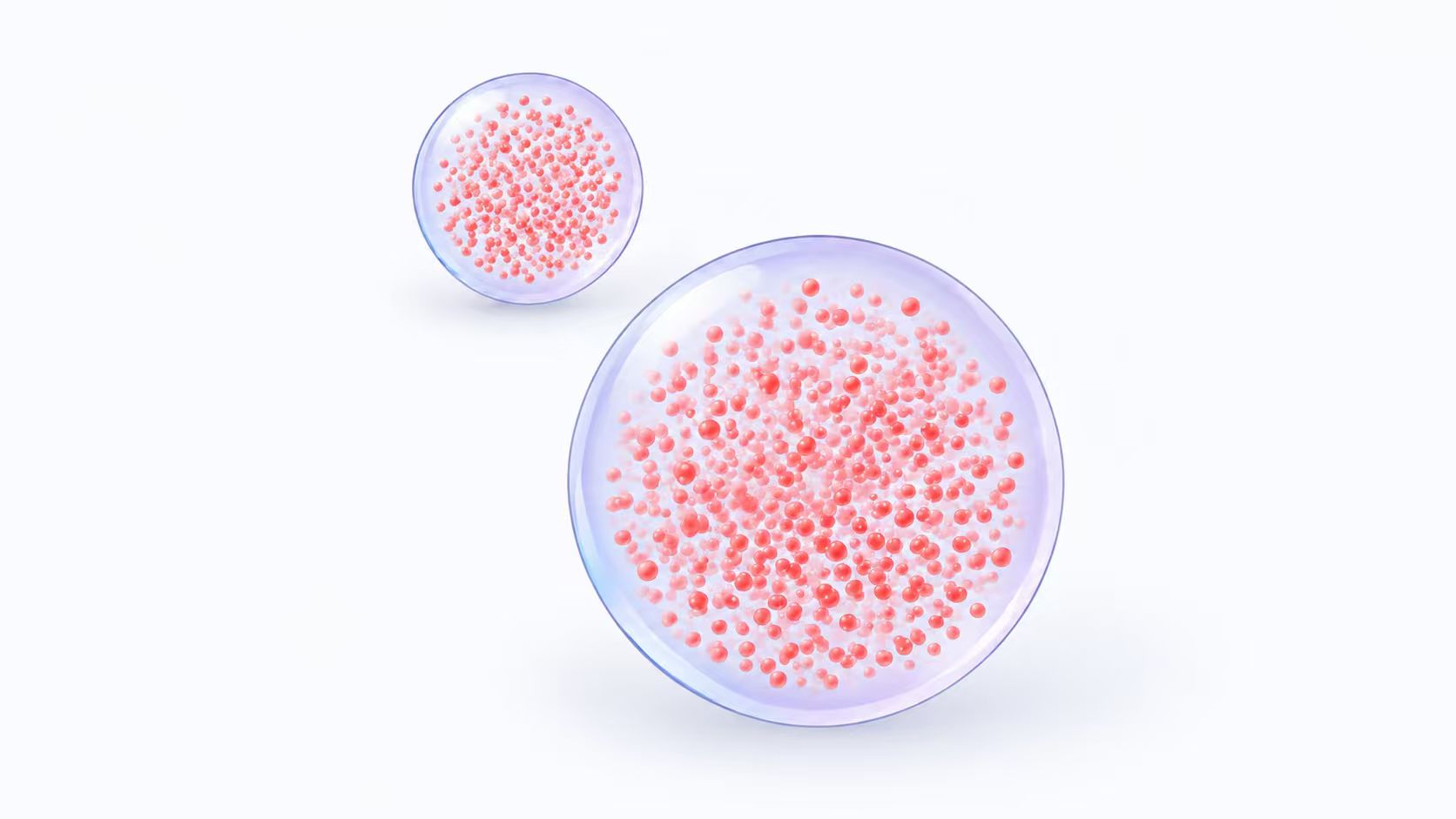
A quantum dot is not the same as a display pixel. In a microdisplay device, the color-conversion region associated with one pixel contains many of these nanoparticles.
What happens when light reaches a quantum dot
Consider quantum dots that emit red light when excited by blue light. We can start by looking at how a single dot emits light.
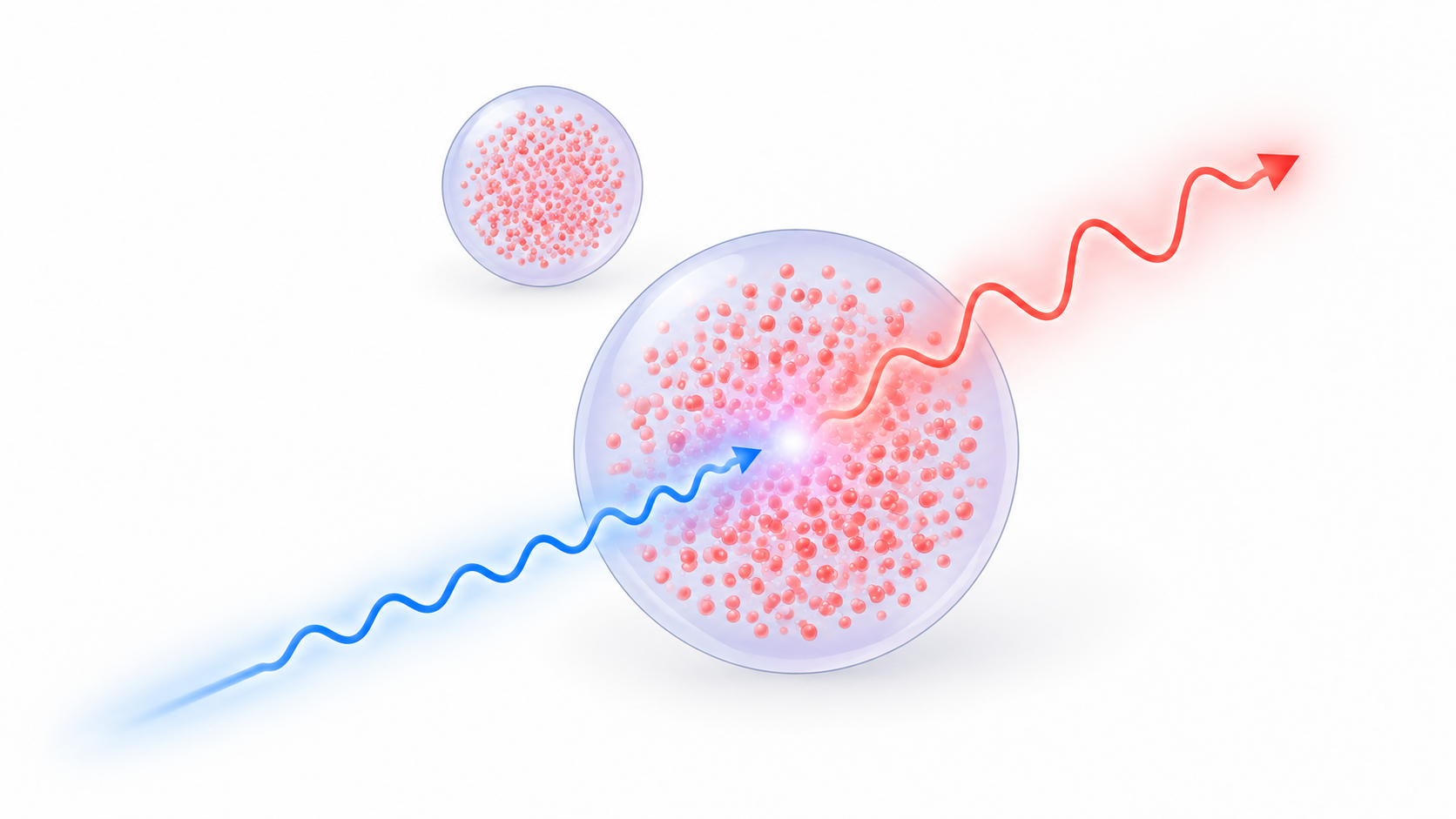
When blue light reaches the quantum dot, some of it can be absorbed. Absorbing a photon excites an electron to a higher-energy state, leaving behind an unoccupied electron state known as a hole.
The electron and hole can then recombine, releasing a photon. Under continuous illumination, large numbers of quantum dots undergo this absorption and emission process, producing the light we observe from the material.
This process of light emission triggered by illumination is called photoluminescence. Here, blue light supplies the energy for excitation, and the excited quantum dots emit red light.
The color of light is related to the energy of its photons. In this example of blue-light excitation and red-light emission, some energy is released as heat or in other forms between absorption and emission. The emitted red photon therefore has less energy and a longer wavelength than the absorbed blue photon. This is why the light used to excite the material and the light emitted by it can have different colors.
Absorbing light does not always lead to light emission. An excited quantum dot can also release energy through a nonradiative pathway, for example as heat, without producing a photon. The blue light absorbed by the material therefore cannot all be counted as red light produced.
The ability of quantum dots to absorb blue light and emit red light offers one way to provide red light for MicroLED displays. To use them in a microdisplay device, however, the material containing the dots must be formed into color-conversion regions that match the pixels, while retaining the required emission performance after processing.
Quantum dot photoresist, mentioned at the beginning, is one way to connect the material to the device. It combines quantum dots with a material that can be patterned by photolithography, allowing regions containing quantum dots to be formed on the device according to the design.
Hongshi develops and prepares quantum dot materials in-house for MicroLED color-conversion applications. At the device level, Hongshi's QDPR red-light solution combines quantum dot materials with photolithography to achieve red color conversion.
In the XC7 RGB-color light engine on Hongshi's Yunjin platform, quantum dot color conversion supplies the light for the red channel. This light combines with the green and blue channels to form a color image. The optical combining, alignment and calibration discussed in earlier articles thus lead us back to the light source: the red light in one of the imaging channels comes from absorption and emission in these nanoparticles.